

TFP: A Dangerous Sect? A response to slanders circulating on the internet
"There are photos of members worshipping Dr. Plinio."
"The TFP is a cult."
"The TFP was condemned by the Brazilian bishops"
*************************
- What is the TFP for?
- Why do some conservative and traditionalist priests want to alienate their faithful from it?
- Which of the accusations against the TFP could constitute a sin of slander?
First, what is the TFP? Why does it exist?
The TFP is a family of associations inspired by the thought and work of Plinio Corrêa de Oliveira, and dedicated to defending Catholic principles in civil society. Tradition, Family, and Property are the triad that form the basis of any healthy society that respects the natural order. In fact, even the Belgian liberation theologian Max Delespesse recognizes that "Tradition-Family-Property is a coherent block that can be accepted or rejected, but whose elements cannot be separated"[1] . This is why these three pillars of Christian civilization are among the most attacked today by wokeist, socialist, anti-Christian, and anti-family revolution[2] .
Who was Plinio Corrêa de Oliveira?
Plinio Corrêa de Oliveira was born in São Paulo, Brazil, on December 13, 1908. After finishing high school with the Jesuits, he continued his university studies at the University of São Paulo Faculty of Law. There, he founded Catholic University Action (AUC), proving to be the most prominent leader of the Catholic youth movement linked to the Marian Congregations.
At the age of 24, he was elected to the Constitutional Convention on the ticket of the Catholic Electoral League (LEC), which he helped to set up with the support of the episcopate in order to defend the interests of the Church in the new fundamental law. He was both the youngest deputy and the most voted for in the country.
Shortly afterwards, he was appointed professor of the History of Civilization at the University College of the Faculty of Law and, later, of Modern and Contemporary History at the Pontifical Catholic University of São Paulo. From 1935 to 1947, he directed the weekly O Legionário, the unofficial newspaper of the Archdiocese of São Paulo, through which he fought Nazism, Fascism, and Communism, which had seduced some Catholics. In addition, he was the first president of the archdiocesan committee of Catholic Action in the state of São Paulo. In this capacity, he wrote In Defense of Catholic Action in 1943, the first cry of alert against the infiltration of progressive errors into this movement. This denunciation earned him a warm letter of congratulations from Pope Pius XII, but also ostracism from the Brazilian Catholic establishment, which was already contaminated by what would become three decades later Liberation Theology.
In the 1950s, he played a leading role on the editorial board of the monthly magazine Catolicismo and wrote his masterpiece Revolution and Counter-Revolution, published in five languages and with more than one hundred thousand copies in circulation. This work analyses the process of de-Christianization of temporal society and the secularization of spiritual society, as well as the methods to halt this process and therefore restore Christian civilization. Revolution and Counter-Revolution would become the bedside book of TFP members and supporters.
His intellectual work was completed by the following books: Agrarian Reform, A Question of Conscience (1960), in collaboration with two bishops and an economist; The Freedom of the Church in the Communist State: The Impossible Coexistence (1963), with 171,000 copies published in nine languages, and which received a letter of recommendation from the Sacred Congregation of Seminaries and Universities as a "most faithful echo" of the Magisterium's documents; Unperceived Ideological Transshipment and Dialogue; The Church in the Face of the Escalating Communist Threat - Appeal to the Silent Bishops (1976); Indian Tribalism: The Communist-Missionary. Ideal for Brazil. In the Twenty-First Century (1977), I'm Catholic, Can I Be Against Agrarian Reform? (1981); What Does Self-Managing Socialism Mean for Communism: A Barrier? Or a Bridgehead? (1981) printed in 155 publications in 69 countries, totaling 33.5 million copies; Basic Ecclesial Communities? Of Which Much is Said, But Little is Known - The TFP Describes Them As They Are (1982), in collaboration with Gustavo and Luiz Solimeo; Private Property and Free Enterprise in the Agro-Reformist Typhoon (1985), in collaboration with an economist; The Warriors of the Virgin: The Reply of Authenticity; In Brazil, Agrarian Reform Brings Misery to the Countryside and the City (1986); The Constitution Project Distresses the Country (1987); and Nobility and Analogous Traditional Elites in the Allocutions of Pius XII (1994), a work that received letters of recommendation from four cardinals and several renowned theologians.
Plinio Corrêa de Oliveira was also a columnist for Folha de S. Paulo, Brazil's largest newspaper, and continued to write regularly for the monthly magazine Catolicismo.
Plinio Corrêa de Oliveira's greatest achievement, however, was the founding, in 1960, of the Brazilian Society in Defense of Tradition, Family and Property - TFP, the direct result of a lifetime of activity as a writer, university professor, journalist and orator.
Following the model of its Brazilian predecessor, many other TFP organizations have since been founded, working directly or through representative offices in 25 countries on five continents.
For more detailed information on the thought and work of Plinio Corrêa de Oliveira, you can consult the books The Crusader of the Twentieth Century and Prophet of the Reign of Mary, by professor and historian Roberto de Mattei, former president of Italy's National Council for Scientific Research[3], as well as hundreds of articles and lectures published on the website pliniocorreadeoliveira.info.
It should be noted that, faithful to the teachings of the Church's social doctrine, Plinio Corrêa de Oliveira was an ardent enemy of the totalitarianisms of the twentieth century, refuting their errors and denouncing the crimes of both communism and Nazi-fascism. This earned him the opposition and persecution of left-wing and false right-wing currents, as well as their sympathizers infiltrated within the Church.
But why do TFP members attach so much importance to Dr. Plinio?
Because of his counter-revolutionary work and for being the founder of our family of souls. His biography demonstrates the importance of his work in both civil and Catholic circles. Every year, there are more books, articles, doctoral and master's theses acknowledging the influence of his work.
How many TFPs are there?
For the sake of simplicity, in this document, we use the acronym TFP to refer to this family of associations, present today in 25 countries. Each entity is autonomous, but united by the same ideas and methods of action.
In which European countries are there TFPs or similar organizations?
We are present in Austria, Belgium, France, Germany, Ireland, Italy, the Netherlands, Poland, Portugal, Spain, and the United Kingdom.
What social classes do TFP members come from?
From all social classes and ethnic backgrounds. There are some prominent members from the nobility, the middle class, and the working class, who live together in harmony, as should be the case in a Catholic society.
How does the TFP work?
Throughout its history, the TFP has specialized in influencing public opinion through publications, manifestos, petitions, conferences, and symposiums for the education of young people, and especially through its eye-catching street campaigns, in which it makes direct contact with the population in the streets, universities, and even house-to-house in working-class neighborhoods. Its campaigns are aimed at reinforcing Catholic principles among the public and denouncing the errors and maneuvers of the anti-Christian revolution, whose promoters are giving more and more importance to the culture war. They know that if they succeed in transforming hearts and minds, social and legislative changes will become inevitable. Conversely, the conservative wave that has emerged in the West is the result of persevering cultural and ideological resistance to the excesses of Wokeism, as demonstrated by the reversal of the US Supreme Court decision on abortion.
How effective are the TFP's activities?
The results of TFP's activities are varied, as they depend to a large extent on the response of its target audience or the authorities it addresses. Among the most successful campaigns are the petition supported by one million Brazilians in 1966 against divorce, which led the government to withdraw its bill, and the petition of 5 million people in 1991 in favor of Lithuanian independence from the USSR, a worldwide campaign that comforted the Lithuanian people in their resistance to the imperialism of the Soviet Union and led the Lithuanian Parliament to invite TFP, as the only foreign delegation, to participate in the official ceremony commemorating the tenth anniversary of the country's independence. For several years, this petition appeared in the Guinness Book of Records as the largest petition in history.
One of the best symptoms of the TFP's effectiveness is the virulence of its ideological opponents who consider it a threat to their anti-Christian agenda (see, for example, the study Modern-Day Crusaders in Europe - Tradition Family Property: Analysis of a transnational, ultra-conservative, Catholic-inspired influence network, by Neil Datta, secretary of the European Parliamentary Forum for Sexual and Reproductive Rights, Brussels) [4]
Read also: Some of our victories
How does the virulence of the TFP's ideological opponents manifest itself?
Very few try to refute their books, manifestos, or statements with doctrinal arguments. More often, they make slanderous accusations, such as - from the left - that the TFPs are "ultra-reactionary", "Nazi-fascist" and complicit in the coups d'état and human rights violations of the military dictatorships in Latin America.
The accusation of Nazi-fascism is particularly absurd, given that in the years 1935-1945, Plinio Corrêa de Oliveira published more than a thousand articles against Hitler and his allies. Equally inconsistent is the accusation that they are "ultra-reactionaries", because their interventions in public debate are always based on Catholic doctrine, and their activities are peaceful and legal.
While it is true that various TFPs supported some military interventions against regimes that were establishing communist dictatorships in their countries, they always made it clear that they considered such an interruption of democratic constitutionality to be a lesser evil, as long as these regimes were provisional and respected the rights of opponents, and that simple criminal repression without ideological work was insufficient. The slightest involvement of any TFP in this repression or in its possible excesses has never been demonstrated.
On the part of the "Nazi-fascist" false right, the TFP is accused of being a "Jewish-Masonic" infiltration (specifically, Anglo-Saxon Freemasonry) in anti-communist circles because of its defense of the West and the United States during the Cold War. For these accusers, the great mistake of the TFP, before the fall of the USSR, was not realizing that the center of the Revolution was on "Wall Street" and not in Moscow. What this false right, supposedly anti-communist, failed to take into account were the repeated papal condemnations of socialism, while the capitalist economic system is considered by the Church to be in itself just, because it is based on private property and free enterprise, and condemnable only in its historical excesses.
But even within the Church, the TFP encounters a lot of opposition...
It is only natural that there should be opposition to it from Catholic sectors that have allowed themselves to be infiltrated or influenced by communist doctrines in the form of Liberation Theology. Since 1960 and until the fall of the Berlin Wall, the main activity of the TFPs was to denounce the complicity of Catholic bishops, priests, and associations with the left-wing agenda, in the name of the "preferential option for the poor". During the pontificate of Paul VI, this opposition of the bishops of Chile, Uruguay and Brazil was particularly virulent, against whom the respective TFPs published the books The Church of Silence in Chile, Leftism in the Church, Communism's Fellow Traveler on the Long Adventure of its Failures and Disillusions, and The Escalation of the Communist Threat - An Appeal to Silent Bishops.
Less blatant but equally virulent was the opposition of Catholic sectors infiltrated by Nazi-fascist tendencies, as was the case of a Mexican association which prevented the TFP from joining the World Anticommunist League in the 1970s on the pretext that it was a longa manus of the Zionist movement in collusion with North American capitalism[5]. Another was the opposition to the TFP of the late Bishop Richard Williamson, a bishop irregularly ordained by Bishop Marcel Lefebvre in 1988 and later expelled from the FSSPX for his denial of the existence of the gas chambers in the Nazi concentration camps, statements which earned him condemnation by the German courts.
But does the TFP have friends and sympathizers within the Church, particularly among the clergy and members of the hierarchy?
Many of his initiatives have received warm expressions of support from high-ranking prelates. Even before the founding of the first TFP, Plinio Corrêa de Oliveira received a letter of approval on behalf of Pope Pius XII from the then Cardinal Giovanni Battista Montini, the future Pope Paul VI, for his book In Defense of Catholic Action, which denounced the doctrinal and pastoral deviations that had infiltrated various documents of the Second Vatican Council 20 years in advance. His book The Freedom of the Church in the Communist State was described as a "most faithful echo of the Supreme Magisterium" by the Prefect of the Sacred Congregation for Seminaries and Universities, Cardinal Giuseppe Pizzardo. His book Nobility and the Analogous Traditional Elites in the Allocutions of Pope Pius XII received many letters of support from ecclesiastics, including cardinals of the Roman Curia.
The last two TFP works to receive public support from high-ranking prelates were The Synodal Process Is a Pandora's Box: 100 Questions & Answers (2023), prefaced by Cardinal Raymond Leo Burke, and The Breached Dam: The Fiducia Supplicans Surrender to the Homosexual Movement (2024), prefaced by Bishop Robert Mutsaerts, auxiliary of S'Hertogenbosch (Holland), both written by Julio Loredo and José Antonio Ureta.
Numerous TFP campaigns have received public support from Bishops and prominent members of the clergy in their respective countries. For example, the 2015 Filial Supplication to Pope Francis in defense of the family, promoted in cooperation with other entities, received one million signatures, including those of 202 prelates, including cardinals, archbishops, and bishops, all of them obtained by the TFPs on five continents.[6]
When the French TFP was sued in court on slanderous charges of fraud and false advertising in its campaign to spread the Miraculous Medal (6 million of which were distributed in France), 8 cardinals, 11 archbishops, and 30 other bishops sent letters defending the TFP, which were submitted to the court.
This support is significant, but not numerous considering that the TFPs are on every continent and that the Church has more than 5,000 bishops...
Unfortunately, this is mainly the result of the process of self-demolition that the Church has been undergoing since the 1930s, when the errors of Modernism condemned by Pope Saint Pius X began to resurface in her midst. A large minority of cardinals and bishops have openly embraced the Zeitgeist in the name of adapting the Church to the world. Another sizable portion has remained silent, often for fear of reprisals, especially during the pontificate of Pope Francis. These ecclesiastics do not give their support and friendship to the TFP in a public and open way, preferring a discreet relationship and helping it above all through prayer and private encouragement.
So why do some conservative and traditional priests warn their faithful against the TFP?
We do note, and with sadness, that some priests, sometimes conservative and traditionalist, promote a silent campaign against us. But they are a tiny minority compared to those who support us, and, despite their doctrinal closeness, they refuse to approach us to resolve any doubts or objections they have about us. So we don't know for sure what their objections might be.
This silent and veiled work of slander - since its authors usually don't publish their reservations or accusations against the TFP - prevents us from mounting a defense. This, however, detracts from the value of these accusations since it shows that our accusers are, at best, insecure and uncertain, and, at worst, cowardly and in bad faith.
From time to time, we receive feedback from perplexed young people who, after taking part in some of our activities (formation conferences, rosaries, and public campaigns, etc.), receive warnings from their chaplains or spiritual directors, without proof, about the supposedly "sectarian" nature of the TFP, sometimes even forbidding them to maintain any contact with it.
The curious thing is that sometimes these warnings come from traditionalist fraternities that are in an irregular canonical situation or from charismatic communities whose founders have been found guilty of psychologically abusing their disciples.
If they were sincere in their concern to combat "sectarianism", these priests shouldn't be practicing it themselves in relation to the TFP, but should at least seek out its members and, in a frank and open conversation, paternally correct them. What is incomprehensible is that they recycle and spread calumnies that have already been refuted.
Why doesn't the TFP make a public complaint against these priests who slander it?
Firstly, for the obvious reason that, since this is a work of discrediting through rumors, we have no incontrovertible proof of the slanderous nature of these private comments, nor a precise version of the allegations that are made.
But above all, we remain quiet because in our times, when signs of spiritual and moral decadence are multiplying throughout the world, Catholics need more than ever to join forces and present an unbreakable unity and cohesion against the enemies of the Faith.
For this reason, we have avoided even mentioning by name some of the accusers we are familiar with.
Why do these slanderous rumors seem to have intensified recently?
It's a question that our detractors would have a duty to answer, all the more so because the facts they cite took place many years ago. The only answer that seems plausible to us is that, in recent years, the activities of the TFPs in Europe have increased, especially the fight against abortion and in defense of the family as God made it. This explains the increase in intensity of the attacks against us from the 'woke' left, but it doesn't explain the growth of malicious rumors in Catholic sectors that should be happy with these activities of the TFPs. One explanation could be envy, a capital vice that is unfortunately present even in Catholic environments. Another would be "competition", as sometimes happens even among Ecclesia Dei communities, where seminary candidates compete. The most serious explanation would be an under-the-table alliance between the extreme left and the extreme right along the lines of the Ribbentrop-Molotov Pact, which preceded the simultaneous invasion of Poland by Communist Russia and Nazi Germany.
What is the difference between the attacks coming from the left and those coming from the Nazi-fascist false right?
Historically, attacks from the left against the TFP are usually made in public, through the print or digital media, while those from the Nazi-fascist camp are almost always made in the shadows, without giving us the chance to respond. Another difference is that the leftist attacks are usually about ideological issues involved in some campaign we're running at the moment. Those from the right are usually repetitions of old slanders, already answered and clarified, but never refuted by the opposing party.
What moral fault is committed by those who spread slander?
The Church teaches that slander is a terrible sin that violates the 8th Commandment. Slander is a lie. It deprives and destroys someone, not of their material possessions, but of something more precious: their good name. The Church proclaims the right of Catholics to their good name. Canon 220 states: "No one can illicitly harm the good reputation of another person".
The fault of slander is so serious that the Church takes the most severe measures against it. For example, in question 68 of the Summa Theologiae, s.s., a.4, Saint Thomas quotes Pope Adrian I: "He who cannot prove his accusation must himself suffer the punishment that his accusation entailed."
Saint Thomas comments: "He who unjustly accuses sins both against the person accused and against the community; therefore, they are punished for both crimes. (...) The accuser deserves the punishment of retaliation in compensation for the harm he tries to inflict on his neighbor; but the punishment of disgrace is due to him for his wickedness in slanderously accusing another man.”
Does the same apply to the sin of backbiting?
Yes, explains Saint Thomas, Q.73 Secunda secundae:
Just as one man harms another by deed in two ways - openly, as by robbery or any kind of violence, and secretly, as by theft or a cunning coup - so one man harms another by word in two ways - in one way openly, and this is done by means of insults, as stated above (II-II:72:1) - and in another way secretly, and this is done by means of malediction. (...) Malediction, by its very nature, aims to tarnish a man's good reputation. Therefore, properly speaking, to curse is to speak ill of an absent person in order to tarnish his good reputation. Now, it is a very serious matter to tarnish a man's good name, because of all temporal things, a man's good name seems to be the most precious, since without it, he is prevented from doing many things well. If such slanderous words are uttered out of some good necessity and with attention to the proper circumstances, it is not a sin and cannot be called slander. But if they are uttered lightly or for some unnecessary reason, it is not a mortal sin, unless, by chance, the word uttered is of such a serious nature that it causes notable damage to a man's good reputation, especially in matters concerning his moral character, because, by the very nature of the words, this would be a mortal sin. And it is obligatory to restore a person's good reputation, no less than anything else that has been taken from him, in the manner indicated above (II-II:62:2) when we dealt with restitution.
And what is the fault of those who spread rumors without checking their veracity?
It is the sin of reckless judgment. The universal consensus among moral theologians is that it is not lawful to form a judgment about a person or an institution without first diligently and honestly verifying all the relevant information. This moral imperative is even more serious when the good name and honor of a person or institution that is selflessly dedicated to the Church and Christian civilization are at stake. The right to a good reputation - a principle of natural justice - is serious enough to have been included in the new Code of Canon Law.[7]
Before spreading rumors against someone, one has a serious moral duty to corroborate the veracity of these allegations and, in particular, to investigate whether the accused person has anything to say for themselves. Failure to do so can constitute a serious offense against justice, not to mention charity. Unfortunately, this ethical procedure is often not followed by the TFPs' accusers.
What is the obligation of those who realize that they have spread slanderous or defamatory rumors against innocent people or entities?
As in the case of theft, the defamer is morally obliged to make restitution in order to repair the good name of the defamed person or institution. As well as violating Christian morality, the procedure followed by our detractors also disregards another fundamental principle of natural justice: audiatur et altera pars - that the other party should also be heard. It is a constant feature of the judicial system in all civilized countries that the accused, even the worst criminal, always has the right to a defense.
However, the promoters of the defamatory campaigns against the TFP do not fulfill this obligation.
But the TFPs have some characteristics that are unusual in other Catholic movements and that give them the appearance of a sect. What do you say about that?
Legally, the TFPs are of a mixed nature. If seen from the perspective of the laws of the state, they are civic societies, governed by civil statutes. If seen from the perspective of Canon Law, they can be considered as private associations of the faithful who have not voluntarily requested canonical recognition from any ecclesiastical authority (canon 299 § 3), nor have they sought to obtain ecclesiastical juridical personality (canon 322), since - given the crisis in the Church - they have preferred to remain, at ecclesiastical level, only as de facto associations. Like all the faithful, they are subject to the supervision of the bishops in matters of faith, morals, and ecclesiastical discipline, but they are not subject, as associations, to the rule of ecclesiastical authority. All the canonists consulted have been unanimous in declaring that it is not necessary to request canonical recognition in order to carry out the kind of activities that the TFPs carry out.
The fact that their volunteers consecrate their lives to the counter-revolutionary ideal and that most of them remain celibate and live in the associations' residences does not change their canonical status, nor does it turn them into a "sect", because the imitation of certain material aspects of consecrated life is not only permitted, but even encouraged in the Church.
The legitimacy of this status is confirmed by the fact that, in their entire history of activity throughout the world, the TFPs have never been the object of any canonical investigation or ecclesiastical censure, either from a doctrinal point of view or from the point of view of morals and discipline. Ever since Plinio Corrêa de Oliveira began to act publicly in 1928, he and his followers have refuted accusations in good time, and to this day, there hasn't even been a sufficient rejoinder from his detractors.
But the Brazilian TFP was condemned by the Brazilian Bishops' Conference...
This is not true. As we have said, there has never been a canonical investigation resulting in the TFP being condemned. What the Brazilian Bishops' Conference did was approve a simple "Note" in the form of a press release, dated April 19, 1985. This note states that "the lack of communion of the TFP (Brazilian Society for the Defense of Tradition, Family and Property) with the Church in Brazil, its Hierarchy and the Holy Father is notorious" and that they regret "the inconveniences resulting from a civil society that manifests itself as a Catholic religious entity, with no connection to the legitimate pastors" and therefore "exhort Catholics not to register with the TFP and not to collaborate with it".
The one-sidedness and bad faith of the accusation of a "lack of communion with the Holy Father" is evident when you consider that just three weeks later, seventeen prominent Brazilian archbishops and bishops publicly expressed their "non-conformity" with the notification from the Congregation for the Doctrine of the Faith condemning a book by the liberation theologian and ex-friar Leonardo Boff. But the same Episcopal Conference did not say a word of disapproval of the "notorious lack of communion" of these prelates with Pope John Paul II, who had approved the notification.
The proximity in time of the two events - the note against the TFP and the condemnation of Leonardo Boff - and the reference to the "lack of communion" with the Church in Brazil were no coincidence. The Brazilian TFP had, in fact, carried out a vast campaign for three years to disseminate a book against the Basic Ecclesial Communities promoted by Liberation Theology, which had irritated the leadership of the Conference of Bishops who had supported them. A bishop who was part of the commission that drafted the note even suggested that the TFP should be explicitly censured for having carried out this campaign against the Basic Communities, but the majority disapproved of the proposal.
They preferred to claim that "according to reports" (in the press), some aspects of the organization could "in no way merit the approval of the Church". These were "the abusive use of the name of the Blessed Virgin Mary", its "religious fanaticism", and "the cult of personality of its leader and founder". These were groundless accusations from a tiny group of former TFP members, which had already been refuted in three books[8] and which had received no response, but which the bishops hadn't bothered to read, let alone refute.
It is understandable that bishops favorable to Liberation Theology condemn the TFP. But why was it the subject of a report circulated in traditionalist circles in France, which accused it of being a "sect"?
In 1979, certain traditionalist circles published a slanderous and anonymous pamphlet entitled La TFP, secte ou pas secte? Its main accusation was that the TFP wanted a Church without clergy, run by lay people. The "masterstroke" for this absurd accusation was the fact that, in the TFP, the term "structure" is used to refer to the modernist elements of the Hierarchy that promote the process of self-demolition of the Church deplored by Pope Paul VI, which unfortunately constitute the main part of its structure. Since it would be neither fair nor filial to attribute the reprehensible positions and attitudes of these demolishing prelates to the Holy Church, the word "structure" has been used, for convenience of language, to designate the bloc of those responsible or complicit in this catastrophe.
The bad faith of the accusation is evident when one considers that in these same "traditionalist" circles, a much stronger expression is used to designate this sad reality: "the conciliar Church". This, moreover, is very dangerous, because it can mislead the listener into assuming that the members of the Hierarchy who adhere to Vatican II (the vast majority) constitute a religious entity that is no longer the Catholic Church.[9]
The French TFP promptly refuted these accusations in the book Imbroglio, détraction, délire - Considérations à propos d'un Rapport concernant les TFP, which carried a label on its cover summarizing the case: "Assessment of a report - The thesis: absurd; the argument: inconsistent; the witnesses: anonymous". Needless to say, this rebuttal never received a response from the anonymous authors of the pamphlet. This did not stop their fanciful accusations from being taken up fifteen years later in the book Les sectes - Etat d'urgence, published by the Centre Roger-Ikor, a secular association subsidized by the French state and founded by a writer of the same name whose son, a Zen macrobiotic adherent, had committed suicide. Later, this same association published a Dictionary in which it did not hesitate to classify the Focolari Movement, the Community of Beatitudes, the Prelature of Opus Dei, Buisson Ardent, the Legionaries of Christ, and Chemin Neuf as sects. After its publication, the national Catholic organization “Pastoral, Sects and New Beliefs” published a critical document from the French episcopate, signed by Bishop Jean Vernette, its secretary, which read: "The definitions given to the constitutive realities of the Christian faith are worrying, for example in the entries: Doctrine, Sin, Confession, or again Prayer, Contemplation, Conversion. The usual line of thought of the 'Rationalist Union', of 'Free Thought', of Freemasonry in its atheist version, can be seen in them."
We see here a strange repetition of the Ribbentrop-Molotov pact: atheists, probably Freemasons, spread slander by some anonymous "traditionalists" and, conversely, these "traditionalists" justify their distancing from the TFP in the name of the warning note from the Brazilian bishops linked to Liberation Theology.
But the accusation is true because the French TFP appeared on the list of sects in a report by the French National Assembly...
It is interesting to know the origin of this list, included in the so-called Guyard Report, named after the Socialist deputy who chaired the parliamentary committee of inquiry. The report itself openly acknowledges that the part dedicated to the doctrinal analysis of the movements considered by the Secret Service (equivalent to the FBI in France) to be sects is taken directly from "a synthesis of the information contained on the subject in Les sectes - Etat d'urgence" (Sects - State of Emergency), the aforementioned book written by the Roger-Ikor Center. Thus, as far as the TFP is concerned, the Guyard Report is just an ipsis verbis extract of the three pages that this book devotes to it.
The sectarian characteristics attributed by the Guyard Report to the French TFP, described as a "pseudo-Catholic" group, are the fact that it wants to "restore Christian civilization, fight socialism and re-establish the monarchy". Even if we consider that it might be necessary to clarify in which countries the TFP suggests "restoring the monarchy", we don't see why these objectives should be considered heretical or incompatible with Catholic social doctrine. While it is true that TFP's activities (in particular its campaign against agrarian reform in Brazil, mentioned in the report) have aroused opposition from local Catholic bishops, other bishops and cardinals around the world have warmly praised TFP's activities.
The late Cardinal Bernardino Echeverría, archbishop emeritus of Guayaquil (Ecuador), wrote to the president of the French National Assembly to protest against the inclusion of the TFP in the list of sects. In his letter, he writes:
"As the former Archbishop of Guayaquil, for more than 20 years, I carefully observed the development of the Ecuadorian TFP and its Latin American sisters, their internal life, and their public activities. I had the opportunity to get to know many members and leaders of various TFP personally, and to appreciate their fidelity to the doctrine and practices of the Catholic Church.
It is this same fidelity that has sometimes earned them persecution from their ideological adversaries - openly Marxist socialists or even some sheep led astray by so-called Liberation Theology. One of the forms this persecution has taken is precisely the spreading of slander through the media, in particular that of "sect", of which the Report in question echoes. (...)
"I'm surprised that a parliamentary committee in a secular state like France wants to interfere in the internal life of the Catholic Church and decide in its name who is Catholic, pseudo-Catholic, or non-Catholic. By what right, in fact, does the parliamentary committee in question describe as a 'pseudo-Catholic sect' a movement that has never received the slightest canonical sanction and whose various works written by its founder have earned the praise of the Holy See?"
But one of the accusations of both the Brazilian bishops and the "traditionalists" refers to the "personality cult of their leader and progenitor", that is, Professor Plinio and his mother, Dona Lucília.
This accusation seems to presuppose that veneration paid to a person who has not been canonized or beatified, or homage paid to a living person, is ipso facto contrary to the doctrines and laws of the Church. It presupposes that the only legitimate veneration is that paid to canonized or beatified persons. This is not the Church's teaching. Furthermore, these opponents also seem to think that any sign of respect and veneration for a living person contravenes the Church's provisions. Once again, this is not what the Church teaches.
As for the manifestations of veneration for Professor Plinio when he was still alive, they are part of what the Church calls acts of dulia or acts of civic veneration - in the terminology of Saint Thomas Aquinas - and they are perfectly in line with the doctrine and laws of the Church. Similar acts can be found in the lives of many saints and even in the lives of great men or national heroes who distinguished themselves in their service to their country. For this reason, the Church allows ceremonial marks of respect and acts of veneration, even of a collective nature, not only for the dead but also for the living. Living people can even be asked to help us with their prayers.
When it comes to worshipping the dead, what the Church forbids is public worship, reserved for the Saints and the Blessed, such as erecting altars, celebrating Masses in their honor, promoting official veneration and processions with their relics, painting pictures with aureoles or resplendence, etc. TFP members' devotion to Dona Lucilia has never exceeded the limits of what the Church prescribes.
But can such acts of dulia or civic veneration of the living go as far as what you see in the photos circulating on the internet of TFP members in Brazil, prostrate on the ground, "worshipping" its founder? Isn't that sectarian?
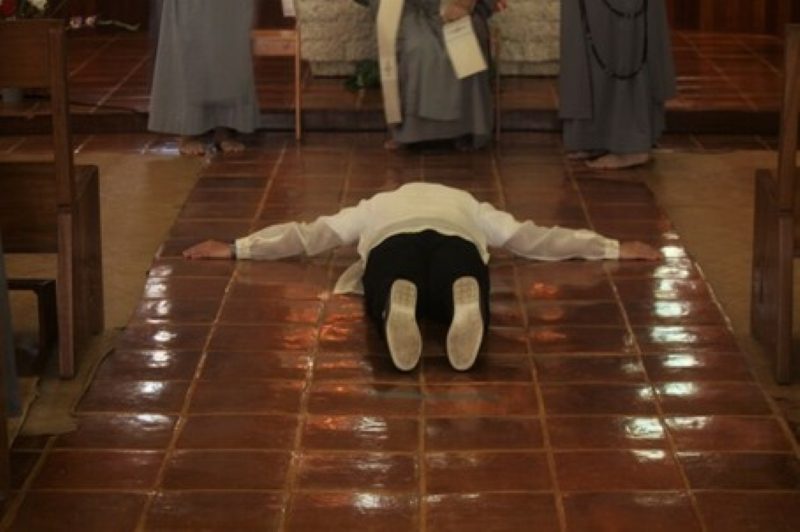
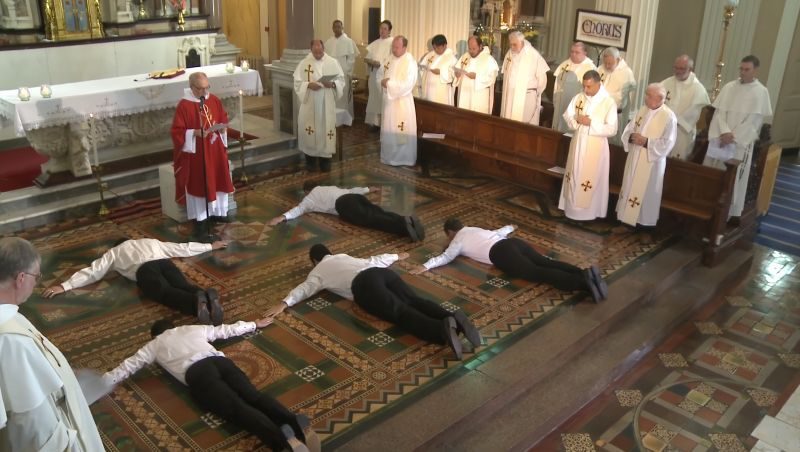
These photos correspond to ceremonies to receive the gala uniform worn by members of the TFPs on solemn occasions, whether in public or in private. It's similar to what happens in religious orders, equestrian orders (Malta, Holy Sepulchre, Teutonic, etc.), and third orders when they receive their habit. In the respective traditional rituals, the person receiving the habit most often prostrates himself before the superior as part of the ceremony. In ordination or religious profession ceremonies, this prostration has several meanings: recognizing one's own smallness in the face of God's greatness and imploring his mercy; giving one's life fully to the mission that is about to be undertaken; and underlining one's communion with the whole Church - both earthly and heavenly.
The photos below bear witness to this venerable Catholic tradition, deservedly respected even by communities whose members (or at least some of them) spread the accusation of undue worship of Dr. Plinio by his disciples.
Photo 1 - Printscreen of old video, used on social networks to "prove" that TFP worships Professor Plinio - Ceremony at TFP headquarters, in which Professor Plinio sits on a throne
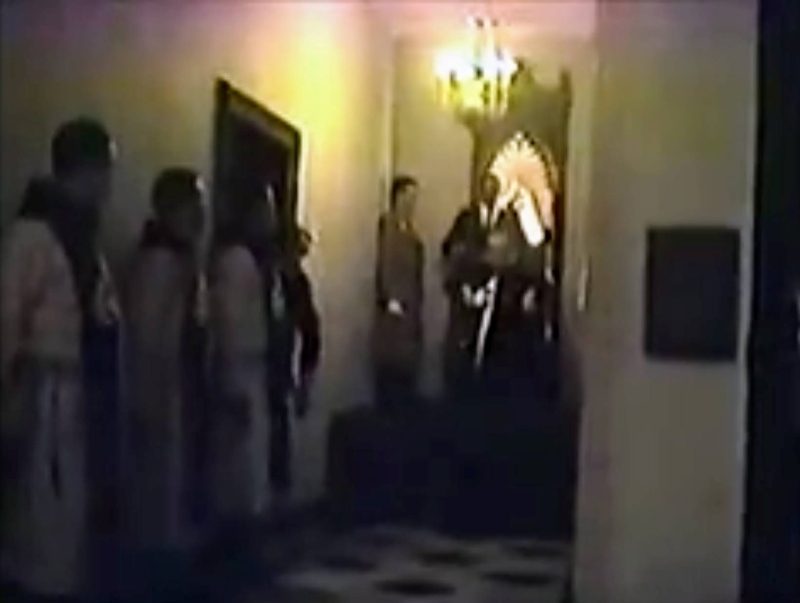
Photo 2 - Chapter of Benedictine nuns in Quebec, the superior sits on a similar throne.
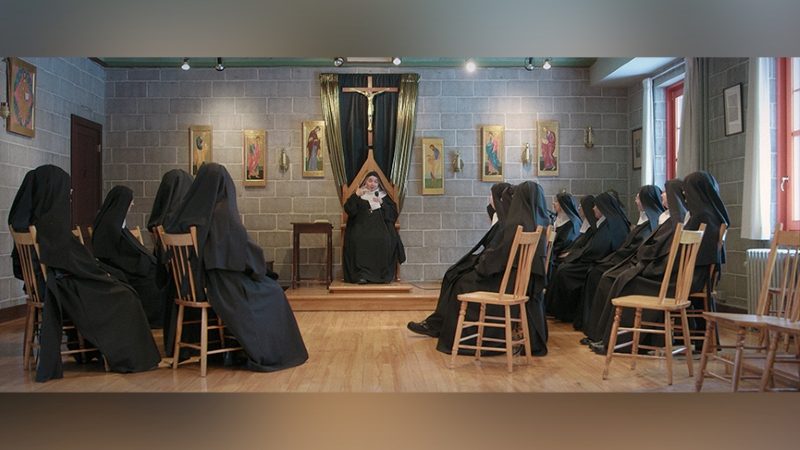
Photo 3 - Members prostrate before Dr. Plinio. Idolatry? No, reception of habit...
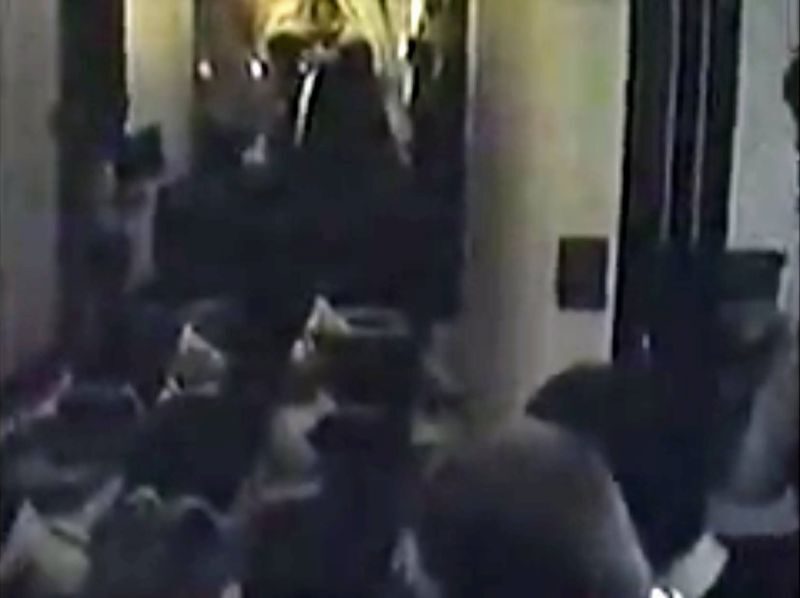
Photo 4 - Lay brother prostrate before his superiors. Idolatry? No reception of habit...
Photos 5 and 6 - SSPX lay brothers kneeling before their superiors (seated and with their backs to the altar). Idolatry? No, entry into the congregation.
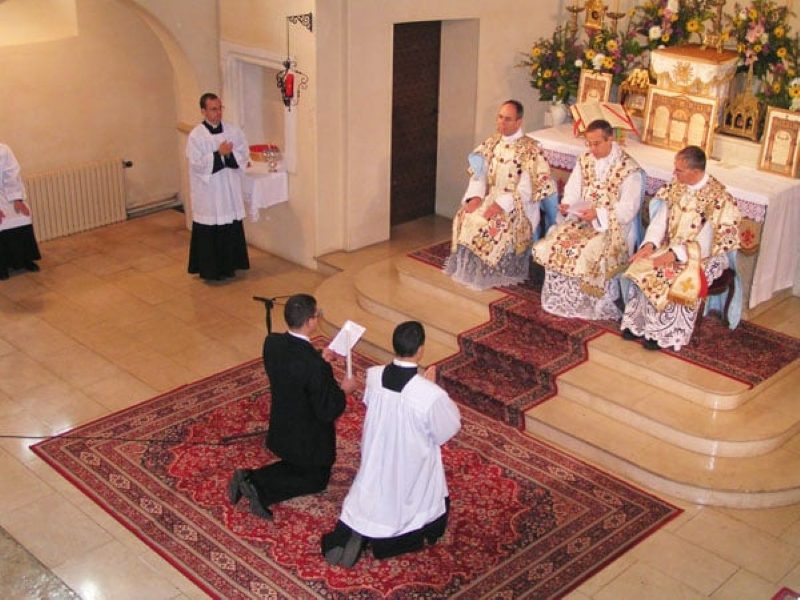
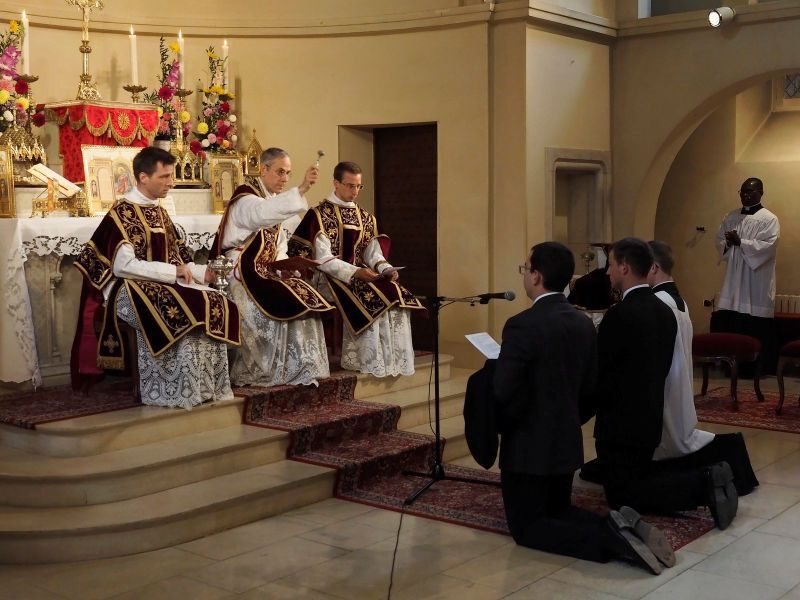
Photo 7 - Montpellier Carmelites. Idolatry? No, reception of habit.
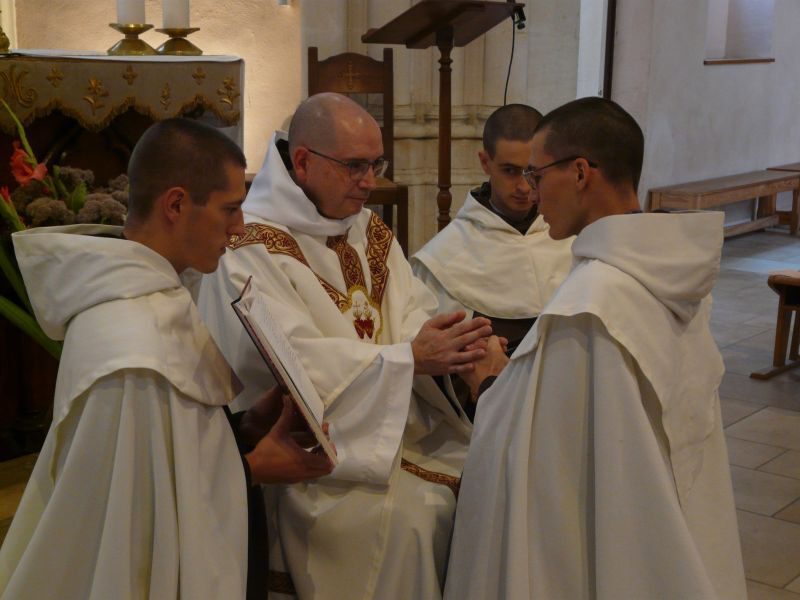
Photos 8 and 9- Trappist monks yesterday and today. Idolatry? No, chapter of guilt and reception of habit.
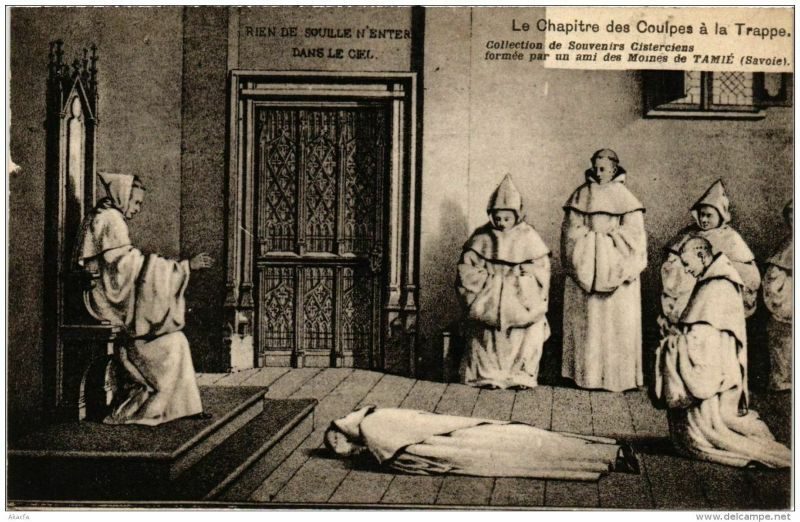
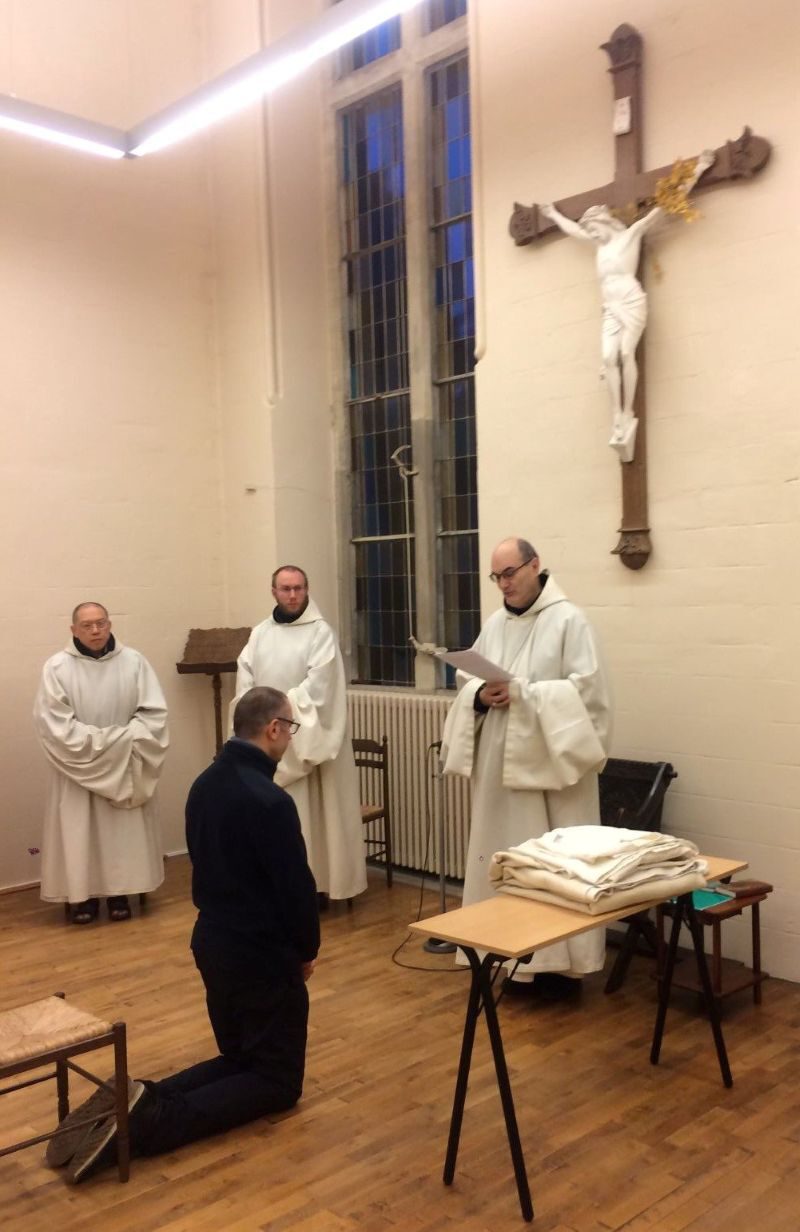
Photo 10 - Ceremonies in the Order of Malta (note that the bishop is standing to one side, and the new knight is kneeling before the superior of the order, who is not even an ecclesiastic...)
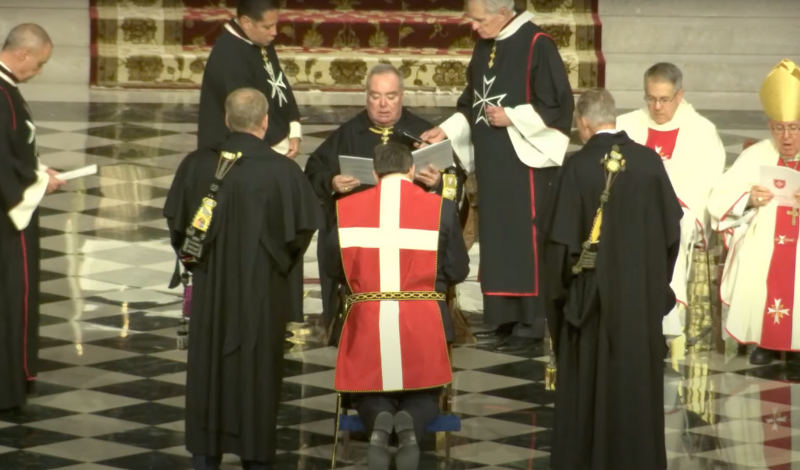
Photo 11 - Order reception
But if the TFP is not an institute of consecrated life recognized by the Church, why do they appear wearing habits, living in common, and maintaining practices of religious orders?
A superficial observer, noticing points of similarity between the life of religious congregations and that of the TFPs, would think that, despite their temporal objectives, their nature is rather that of an institute of consecrated life, and that their canonical statute is inadequate. Is this correct?
No. The material imitation of consecrated life is perfectly accepted by the discipline of the Catholic Church. Numerous pontifical texts, including those of the last Council, as well as norms of canon law, encourage this imitation on the part of lay people living in the world, both individually and in associations.
The few practices of the TFP's internal life, where some of its members, who, for a specific moment, wanted to dedicate themselves more to study and prayer and wear the TFP habit at certain times of the day, are therefore carried out with the utmost respect for Catholic doctrine and the secular traditions of the Church.
For more details on the habit and symbols used in the TFP, see https://tfpstudentactioneurope.org/articles/why-does-the-left-hate-tfp-symbols-so-much
But you have to admit that the TFP has some strange things...
Someone might think the TFP is strange. Why? Why do its members present themselves in public campaigns in jackets and ties? Why do they try to follow Catholic morality in a world that rejects it? If that's being strange, then we're proud of it!
But if the TFP were really "strange" in the sectarian sense of the word, or in the folkloric and popular sense of the term, we wouldn't have tens of millions of people in 28 countries around the world, including thousands of secular and regular religious, who actively participate in our campaigns. And the numbers are only growing.
Isn't the TFP a bit retrograde?
Once again, if it's retrograde to follow Catholic morality, then yes. And thank God for that. If it's going against the woke wave, then yes, we are retrograde.
If retrograde means only worrying about the past, of course not. The TFP is known for studying and getting involved, as far as it can and according to its aims, in the most current issues in the life of each country. Its propaganda methods combine traditional aesthetics with the most modern propaganda methods.
Has any high ecclesiastic spoken out in defense of the TFP in the face of these accusations?
Yes, several.
Shortly after Prof. Plinio Corrêa de Oliveira's death, Cardinal Echeverria Ruiz, then Archbishop of Guayaquil, Ecuador, offered the following testimony:
"It happens that these souls are the victims of the most passionate and unfounded attacks, which try to silence them and illustrate the obstinacy that often permeates the spirit of some classes of men. When the figures are truly great, however, their adversaries can neither bring them down nor silence them, because their unjust attacks end up emphasizing - against their will - the qualities of these chosen souls. This is what happened to the Divine Savior: He was attacked, reviled, and martyred by his executioners, but His light, despite the efforts of so many to destroy it, will shine in His Church until the end of time.
Christianus alter Christus - the Christian is another Christ. Something similar happened to Plinio Corrêa de Oliveira over the decades, until his recent and lamented death. It was difficult to mention his name in recent times on our continent and even in most of the West without triggering applause and admiration on the one hand and, on the other, veritable verbal storms, always so impregnated with passion and so devoid of foundation. In fact, the fury of the attacks he suffered was often devoid of arguments. But his serene response, always courteous and incisively rich, clear and convincing, dispelled the objections and put things in their proper place. This high level of debate earned the gratitude of his enemies, but often triggered hatred, resentment, and disdain."[10]
In 1997, Cardinal Alfons M. Stickler, S.D.B., former librarian and archivist of the Holy See, received a letter from a long-time critic of the TFP complaining about His Eminence's support for the TFP. Cardinal Stickler replied:
"I was surprised to receive your letter presenting certain slanderous voices against the TFP as a novelty, as if I weren't sufficiently informed. In fact, I am very aware of this gossip. Moreover, I have also known the TFP representatives here in Rome very well for almost two decades. Before showing any support for the TFP, I investigated the basis of the rumors against it with extreme care and diligence. I found no evidence to support such smear campaigns. At the same time, the TFP has always responded to such accusations convincingly. The mention of such rebuttals in your letter is notably absent. (...) But what really perplexes and saddens me is that such false testimony occurs in circles that should be united and focused on defending our great common cause of the Church, instead of wasting energies in this way."
Does the TFP have any published material responding to the various accusations?
Yes, and many. Whenever it has been attacked in public, the TFP has responded calmly but firmly, with an abundance of documents, often submitting its rebuttals to renowned canonists.
Here are some of them
"The TFP answers" - Available at the link: https://www.pliniocorreadeoliveira.info/UK_2007_The_TFP_answers.pdf
Analyse par la TFP brésilienne d'une prise de position de la CNBB sur la "TFP et sa famille d'âmes" [Analysis of the Brazilian TFP on a position taken by the CNBB regarding "TFP and its family of souls"] (mimeograph by Societé française pour la defense de la tradition, famille, et propriété, 1989), 49 pp.
The TFP's Defense Against Fidelity's Onslaught: Let the Other Side Also Be Heard (Pleasantville, N.Y.: The American TFP, 1989), 170 pp.
Warriors of the Virgin: The Reply of Authenticity (São Paulo: Artpress, 1986), 350 pp.
Imbroglio, Detraction, Delirium-Remarks on a Report About the TFPs- Verdict on a Report-the Thesis: Absurd; the Argumentation: Groundless; the Witnesses: Anonymous (Pleasantville, N.Y.: The American TFP, 1983), 260 pp.
The Guyard Report in the Light of Catholic Doctrine and French Law
The NCBB Note on the Brazilian TFP: Unfounded Statements, Biased and Impassioned Assessments (Spring Grove, Penn.: The American TFP, 1997), 14 pp.
Refutação da TFP a uma Investida Frustra [The TFP's Reply to a Vain Onslaught] (São Paulo: Artpress, 1984), 498 pp.
Servitudo ex Caritate [Servitude of Love] (São Paulo: Artpress, 1985), 304 pp.
Timely Reflections and Examples of Saints for Our Times (New York: The Foundation for a Christian Civilization, Inc., 1989), 416 pp.
Let the Other Side Also Be Heard: The TFPs' Defense Against an Unprovoked Smear (London, U.K.: Tradition, Family, Property Representative Bureau for the United Kingdom, 1992), 160 pp.
Is it true that TFP members don't get married?
Although there are many TFP members who are married, most members don't marry because they feel called to a special vocation to live one of the evangelical counsels in integrity, that of perfect chastity, or virginity.
A vocation that can contemplate this beautiful form of selfless dedication, carried out in pursuit of the defense of the highest principles of Christian civilization and the Holy Church in a manner analogous to the soldier who sacrifices his personal interests for the defense of the Fatherland. Is there anything wrong with this beautiful act of sacrifice and self-denial? No, quite the opposite!
Some priests claim that the TFP is wrong to practice virginity because its members are not priests. Isn't it wrong to maintain virginity if you're not a priest?
Nothing could be further from the Catholic idea. Pius XII, for example, dedicated an entire encyclical to praising virginity, Sacra Virginitas, and affirmed the importance of people living in society and practicing virginity.
But since the TFP claims to defend the family, wouldn't it be better for society if all TFP members got married and had a beautiful family with lots of children?
History shows that the question makes no sense. Never was the family more developed than when society was mostly Catholic. In this society, there were many vocations, not only to the priesthood, but also to religious life, of men and women who practiced virginity. This tempered the fire of sensuality in those who were married and encouraged them to be faithful to their spouses, which created the perfect social climate for abundant and fruitful offspring.
Do TFP members feel superior for practicing virginity?
It's not a question of whether you think you're superior or not. It's a question of doing God's will. Everyone was created by God with a mission. A person who knows he has no vocation to the priesthood, and seeks it out of some personal interest, is obviously wrong. The TFP is aware of its vocation to defend Catholic principles in temporal society, and the majority of its full-time members practice virginity because they feel called to it by vocation.
Has there ever been a vocation to virginity in the Church outside of the priesthood?
This question makes anyone with the slightest knowledge of Church history smile... How many orders and congregations of non-priestly religious! How many congregations of religious, who obviously can't be priests, who followed the evangelical counsels and took the vows of poverty, obedience, and chastity! In many places in Europe, you can still see street names referring to young women who, without being religious, lived a life of virginity and prayer outside of convents. How many confraternities whose members offered their virginity to God, without ceasing to live an ordinary life in society!
Do TFP members take a vow of poverty, obedience, and chastity?
No. The vows themselves can only be taken in religious orders, with the proper ecclesiastical authorization. TFP members, like any lay person, can take a private vow of chastity if they wish. In TFP, therefore, there are no solemn vows, and there is no obligation to take private vows.
What the TFP does have are houses where study and prayer are promoted, in a private way, for a certain period of time. In these houses, members wear a habit, as explained above.
Conclusion: A call to the priests and laypeople who attack
Today, every Western nation is being invaded by the revolutionary process, which aims to destroy every vestige of Christian civilization. In each of these nations, a defense must be established on the basis of true unity on the Catholic and counter-revolutionary fronts. The TFP is ready for this unity.
We would be acting against our duty if, in this case, these rebuttals were to go beyond the limits of legitimate defense, because we don't want to intensify disunity in an area where we consider unity to be indispensable. By vehemently rejecting the criticisms that have been leveled at us, it is not our intention to lead the recipients of these explanations to mistreat those who oppose us. It is part of the inevitable contingencies of self-defense to express your disagreement or, as the case may be, your indignation at the accusations on the basis of which it was written. Sometimes this means responding by showing your opponents where they have failed to be truthful and fair. But, we insist, this is not an offense. It is a defense.
The solution to such a catastrophic situation in which the world finds itself presupposes, we repeat, the collaboration of all the forces of truly Catholic inspiration, spiritual, moral, cultural, etc., capable of seeing the danger and determined to oppose it with the noblest and holiest extremes of heroism.
WARNING: Anyone who wants to find out will find a thorough defense here. Anyone who wants to attack the TFP will have to prove that they have read this article; otherwise, they will have to admit that they accuse without knowing the cause and judge without hearing the other side.
Footnotes:
[1] Jésus et la triple contestation - Tradition Famille Propriété, Fleurus/Novalis, etc.
[2] For a history of the Brazilian TFP, see Half a Century of Epic Anti-Communism (New York: The Foundation for a Christian Civilization, 1980), 463 pp. The chapter referring to the period which we could call the "pre-history" of the Brazilian TFP (1928-1960) may be obtained separately from the TFP UK Bureau. For a history of the TFPs, see Carlos Federico Ibarguren and Martin Jorge Viano, Tradicion, Familia, Propiedad. Un Ideal, un Lema, una Gesta. La Cruzada del Siglo XX (Sao Paulo: Artpress, 1990), 580 pp.
[3] Il Crociato del XX secolo, Edizioni Fiducia, 1996 / Plinio Corrêa de Oliveira: Apostolo di Fatima, Profeta del Regno di Maria. Edizioni Fiducia, 2017.
[4]https://www.epfweb.org/sites/default/files/2020-06/Modern%20Day%20Crusaders%20in%20Europe%20-%20TFP%20Report.pdf
[5] https://www.pliniocorreadeoliveira.info/wp-content/uploads/2023/08/TD_2022_WACL.pdfe: pg 1196, note 501, pg 1346 and 1347, note 541, pg 1409, pg 1569 and 1570.
[6] https://www.abim.inf.br/filial-suplica-quase-800-mil-assinaturas-sao-entregues-no-vaticano/
[7] Canon 220: "No one is permitted to damage unlawfully the good reputation which another
person enjoys".
[8] They are Refutação da TFP a uma investida frustra, in two volumes, and Servitudo ex Caritate.
[9] https://laportelatine.org/formation/crise-eglise/nouveau-magistere/peut-on-parler-dune-eglise-conciliaire-par-jean-michel-gleize-fevrier-2013
[10] Cardinal Bernardino Echeverria Ruiz, "Distinguished Apostle, Ardent and Intrepid Polemicist," translated from an article published in El Universo, Guayaquil, Ecuador, November 12, 1995.